
A large credit retailer wanted more predictive power than its own data could give it. Adding the Eighty20 National Segmentation gave it a thousand new variables to model on, and a finding it did not expect.
| Client | Large South African credit and clothing retailer |
| Service | Data Intelligence · Eighty20 National Segmentation (ENS) |
| Capability | Consumer profiling data, model enrichment, credit and collections scoring |
| Outcome | 5% to 8% absolute lift in collections and category prediction models |
The challenge
Our client, a large South African credit and clothing retailer, wanted to understand its customer base better across the country’s demographics in order to improve profitability.
One outcome was specific: could the variables in the Eighty20 National Segmentation improve the retailer’s credit scoring capability if they were integrated into its existing lift models?
The underlying problem was signal. The retailer’s existing credit and collections models were missing predictive signal from broader consumer lifestyle and behaviour, and it was already running credit bureau models alongside them. Whatever was added had to be robust and applicable enough to drive revenue growth, not just to look good in a test.
What we did
The retailer appended the ENS variables to its existing model stack, bringing more than 1,000 consumer profiling variables alongside its internal features.
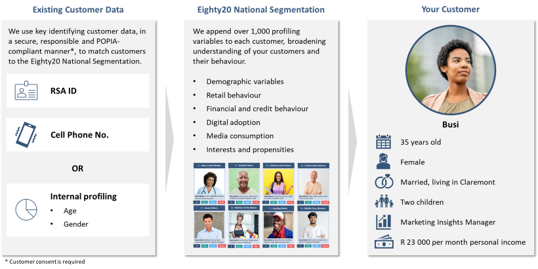
How the ENS attaches to an existing customer base: key identifying data is matched in a secure, POPIA-compliant manner, and over 1,000 profiling variables are appended to each customer.
Rather than assume the new data would help, the retailer set up a straight comparison. Each use case was modelled three ways:
- Using the ENS variables only
- Using the retailer’s internal features only
- Using both combined
The three-way comparison was then run across many use cases: collections, merchandise, sales, including predicting product purchase and markdowns, and communication response models. Around a dozen use cases were tested in total.

The eight main ENS segments. Beneath them sit 46 sub-segments and 1,500 microsegments, each carrying thousands of variables from demographics through to retail, financial, digital and media behaviour.
The result
The client found significant lift across many of the use cases tested. In three in particular the effect was clear and material:
- Collections, new clients with no payment in six months
- Collections, 30 days delinquent at six months
- Category prediction, which category a customer will shop in the next six months
In each of these, adding the ENS variables produced a 5% to 8% absolute lift compared with using internal features alone.
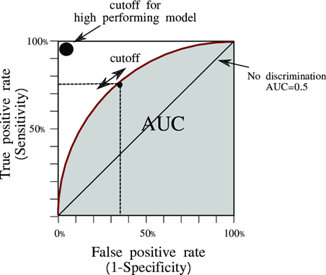
Illustrative only.
Three further findings came out of the work, and they matter more than the headline number:
- The ENS variables on their own were as predictive as the credit bureau models the retailer was using.
- The more ENS variables included in a model, the more lift the retailer saw, which suggests the ceiling had not been reached.
- The ENS gave the retailer new data points that enabled it to build and test models that were not previously possible at all.
The approach is not specific to this retailer. The same models have applicability across a wide range of credit retailers, banks and other credit providers.
|
“Eighty20 is a data science and technology business you’d definitely want in your team and have been a trusted partner of Clicks and ClubCard for many years.”
Customer Marketing Executive, Clicks
Why it worked
Most attempts to improve a credit model start inside the business, with better features engineered from data the business already holds. That runs out eventually, because the data describes the relationship the customer has with you and nothing else.
The ENS describes the rest of the customer’s life: demographics, retail behaviour, financial and credit behaviour, digital adoption and media consumption. That is why it was additive rather than redundant, and why it held up as a standalone predictor against a bureau score.
Wondering whether external data would lift your models? The three-way comparison above is a straightforward test to run. Talk to us about a proof of value on your own use cases.