
Every season, the same voucher, the same hero image and the same offer went out to 700,000 people. It performed respectably as an average and was wrong for almost everyone individually.
| Client | National fashion retailer, South Africa |
| Service | Consulting · Customer Engagement |
| Capability | Personalisation engine, propensity modelling, campaign strategy and execution |
| Outcome | 250% net ROI and roughly R8m in uplift per campaign |
The challenge
Every season the retailer ran the same play. A campaign was designed centrally, a voucher was chosen, a hero image was selected, and the whole thing went out to 700,000 customers at once.
It performed. But it performed as an average. Two customers with completely different purchase histories received an identical offer, because nothing in the campaign was able to tell them apart.
The retailer knew this was leaving money on the table. It simply had no way to act on what it already knew about each customer, at campaign scale, inside a live commercial calendar.
What the business wanted was not an incremental improvement to segmentation. It wanted a state of the art personalisation capability.
What we did
Eighty20 worked as part of the client’s campaign team rather than alongside it, first developing the personalisation strategy and then executing the campaigns themselves across email and SMS.
We built an off-premise campaign and personalisation environment, integrated with the retailer’s CRM, and used it to assemble each communication from the individual customer upward rather than from the campaign brief downward. Customers were targeted at an individual level, each with their own strategy for increasing engagement, cross-sell and up-sell.
Anatomy of a personalised communication
The headline. A personalised hero image and content block, chosen from the customer’s own purchase history and brand loyalty, so the piece opened on something they recognised.

The personalised headline image and copy, selected per customer from purchase history and brand loyalty. Client branding redacted.
The voucher. One spend-and-get voucher, calculated from that customer’s own category spend and purchase history rather than a blanket campaign threshold. A single threshold for everyone is simultaneously too easy for heavy spenders and unreachable for light ones.
The recommendations. Six product recommendations per customer, selected by propensity modelling and deliberately weighted towards products that would bring the customer into a store.
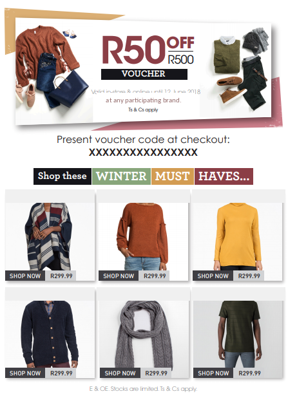
The personalised voucher and six modelled product recommendations. Client and sub-brand names redacted.
The coherence. The product recommendations linked back to the large content image, so a fully personalised email still read as one considered piece of creative rather than a grid of unrelated products.
The constraints. Personalisation that ignores the commercial calendar is useless to a buying team. The same mechanism let us apply real business constraints inside the personalisation logic: campaign budget ceilings, new products the buying team needed to move, and ranges partially funded by suppliers.
The campaign stopped being one message with 700,000 recipients and became 700,000 strategies executed at the same time.
The result
- Net ROI of 250% per campaign
- Approximately R8 million in uplift per campaign, from a base of 700,000 customers
- Increased cross-sell and up-sell across the customer base
- The solution was recognised as industry leading in national marketing awards
|
Beyond the numbers, the retailer moved from running seasonal campaigns to operating a personalisation capability. The engine, the models and the campaign environment stayed in place, which meant each subsequent campaign started from a richer picture of every customer than the last.
“Several ML models have been operationalised with measurable value, including significant improvements in conversion rates.”
Senior Executive, Data Insights, Assupol
A client reference from Eighty20’s wider portfolio, not from the retailer described in this case study.
Why it worked
Personalisation projects usually stall in one of two places. Either the models are good but nothing can execute them, or the execution platform is capable but there is no science behind what it sends.
This one worked because the same team did both, building the propensity models and running the campaigns, and because the personalisation logic was designed from the start to respect commercial reality rather than fight it.