
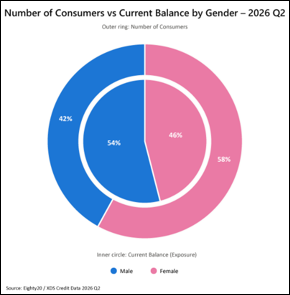
South Africa’s credit market is increasingly a women’s market. Women now make up 58% of all credit active consumers in the country and hold 47% of the total R2.7trn in outstanding balances. That second figure matters as much as the first: women are not only present in the credit system in large numbers but are also carrying a substantial share of its book value too – increasing their share from 44% in 2021 to the present 47%. This sizable representation of females in the credit market is likely a result of a combination of women increasingly using credit as an option for accessing cash to cover the gap between income and expenditure, as well as women increasingly qualifying for high value, secured credit. Indeed, we have seen both exposure and volume of female consumers with secured credit increase by 2% over the last 5 years, supporting the notion of increasing qualification rates.
This extensive representation of women, however, only reflects a few specific segments of the South African consumer landscape – a disparity explained by the labour market, and the sectors in which women are concentrated in employment shape both their income stability and their access to credit. Overall, a third of working women are either in elementary occupations, or domestic workers, compared to a quarter of men. The Quarterly Labour Force Survey (QLFS) for the second quarter of 2026 put the official unemployment rate at 33.6%, with women’s unemployment at 37.5% against 30.3% for men, a gap that has remained stable for most of the past decade, although it has closed considerably since the start of democracy. Covid interrupted that progress, but the longer trend has been towards convergence.
When we look at income and occupation, the data is even more divergent. Employed women are clustered in a narrower band of lower paid occupations: clerical work accounted for 17% of women’s jobs against under six percent for men, domestic work made up almost 11% of women’s employment against 0.5% for men, and managerial roles remained scarcer for women (7%) than men (10%). Average personal income followed the same pattern – women earned R6 447 a month against R9 566 for men, close to a third less.
“The employment and income numbers paint an overall picture,” says Eighty20, South Africa’s leading consumer analytics and research business, “while the credit story is confined to certain segments of the female population.” There is clearly a segment of the consumer landscape where females are increasingly active in the credit space. The ENS segments help us to understand these market segments. Women in the higher income segments (Heavy Hitters, Middle Class Workers and to a limited extent the Mass Credit Market) qualify and take up more debt, while women in lower earning segments have significantly less debt, and primarily retail credit.
For those women dealing with the compounding impact of formal unemployment and non-qualification for credit, the RADIO economic reality is even more challenging. Many have to rely on side-hustles and small enterprises to keep afloat. This (often labelled) informal economy has been shown to be thriving in South Africa. In fact, some estimate the informal economy to contribute roughly R1 Trillion to the GDP. Add those to the credit distribution numbers, and women are carrying a big share of this economy.”
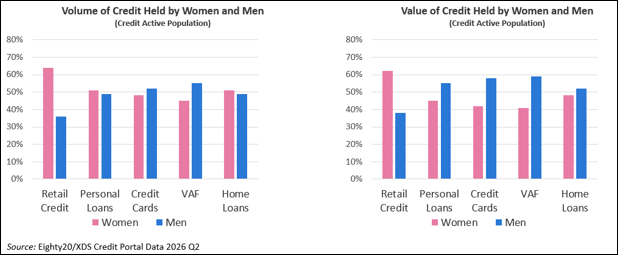
The above charts show the difference in value and volume of credit by gender. The gap is most pronounced in VAF, typically a high-value, secured product, where women hold just 41% of exposure. Traditionally, women have been viewed to take care of ensuring that everybody in the household is clothed and fed. The FinScope data consistently finds the main reason low-income households borrow money is for essential items like food (42%) and clothing (10%).
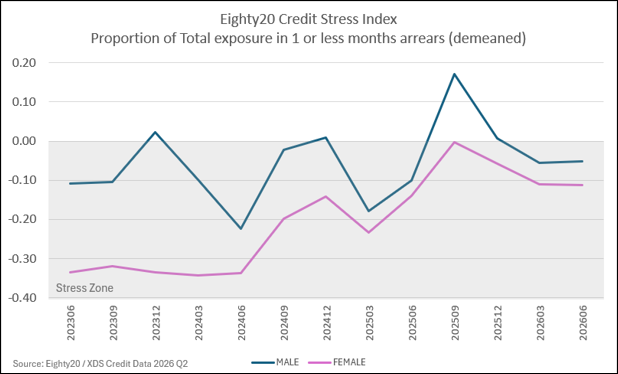
Eighty20 has developed a Credit Stress Index which is indicative of credit stress for all credit-active South Africans in the Eighty20 National Segmentation. We identify accounts in good standing in arrears and calculate the Index using the outstanding balance on these accounts as a percentage of total outstanding balances. This value is then demeaned against the level observed over the last two years, so that the result is a value distributed around zero. A positive index signifies consumers performing better than what has been observed in recent history, and a negative index signifies consumers performing worse, hence in ‘stress’.
From a credit stress perspective, women have shown more credit stress than men since at least mid-2023, though the gap has narrowed over the past two quarters, pointing to a convergence in credit pressure between the genders.
Perhaps the most striking data points are demographic rather than economic. The share of South African women who are married has fallen from 21% in 2006 to 17% in 2026. There is a growing population of single, never-married women, many of them heads of their own households and sole earners. This segment has different credit needs, different risk profiles, and different life-stage triggers for borrowing than women had previously. This is not a niche segment. It is now a substantial and growing share of the adult female population.
Put together, these threads point in one direction: women are not a secondary segment of the credit market. They are most of the active credit base, an increasingly independent and financially self-directed population. A richer understanding of each customer, built on data enrichment and more accurate income estimates, will help lenders keep pace with these shifts. Those who segment their markets in terms of people, rather than products, stand to serve a market that has already arrived, whether or not the industry has fully caught up with it.